
The Sideways Walk
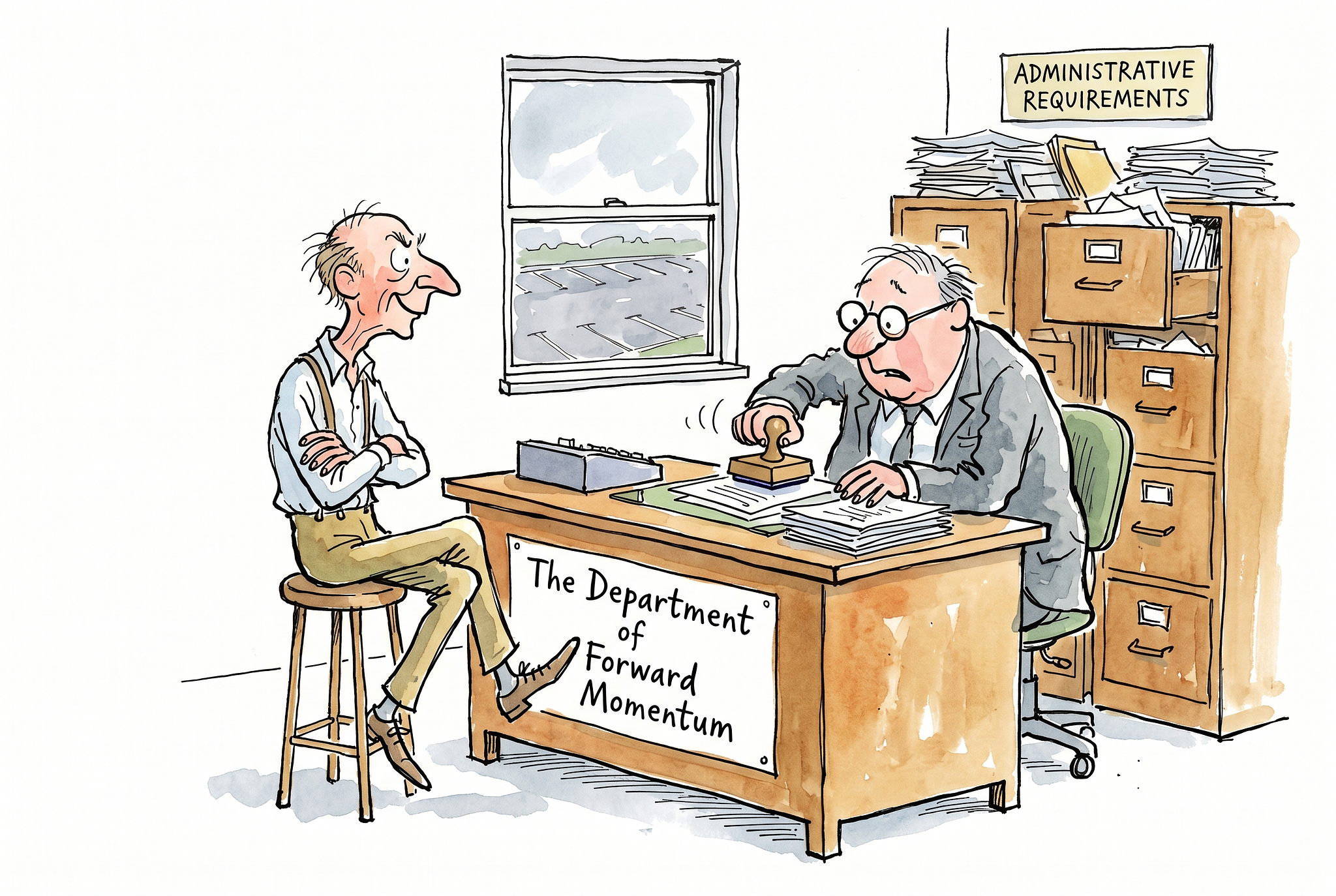
Mr Barnaby Blathers required a licence to walk forwards, which was the most administratively bewildering thing he had encountered since the Tuesday Backward Walking Prohibition of 2019 — a piece of legislation that had passed through Parliament with surprisingly little opposition, mostly because the relevant committee had been walking backwards at the time and missed the vote.
He made his way along the road with the confidence of a man who has decided that today is the day, and that the details will arrange themselves accordingly. They were not arranging themselves accordingly. Several motorists had observations about this, which Barnaby received in the spirit in which they were not intended, and continued.
He arrived, more by probability than design, at The Department of Forward Momentum — a grey building of the kind that exists in every city and which nobody has ever voluntarily entered twice.
The receptionist confirmed his identity with the practised efficiency of someone who has long since stopped being surprised by anything the public brings through the door, and directed him to the first floor, third office on the left.
—You can take the lift or the stairs, she added.
—I have my own, Barnaby said. I shall leave them where they are.
He walked away. The receptionist watched him go with the expression of someone updating a mental filing system that has a very large section marked Miscellaneous.
Mr William Strait was a man of middle height and considerable administrative experience, which had given him the particular quality of stillness that develops in people who have spent many years explaining to other people why they cannot have what they want. He shuffled some papers as Barnaby entered, in the way that people in offices shuffle papers when they already know what they’re about to say and are simply giving it a moment to become inevitable.
—I need to walk forwards, Barnaby said.
—Yes. You are not currently qualified to do so.
—I have been walking sideways since you people introduced cycle lanes.
—That may well be the case.
—It is absolutely the case.
—Nevertheless. In order to issue a Forward Momentum Certificate, I require evidence that you have already been walking forwards for a period of not less than one calendar month.
Barnaby absorbed this. It had the quality of certain administrative requirements — internally coherent, outwardly monstrous — that exist not because anyone designed them to be cruel, but because nobody, at any point in the legislative process, thought carefully enough about what they were actually saying.
—So in order to obtain a licence to walk forwards, said Barnaby carefully, I must first demonstrate that I have been walking forwards.
—For a month, yes.
—Without a licence.
—Correct.
—Which is what I am here because I cannot do.
—Also correct, Mr Strait agreed, in the tone of a man who finds these conversations considerably more straightforward when the applicant understands the situation clearly.
—There is also, Mr Strait added, the matter of the supplementary documentation.
—Of course there is, said Barnaby.
—We require receipts for the footwear purchased as a consequence of your lateral ambulation. Sideways walking creates uneven sole wear, you see. It’s all in the guidance notes.
—I don’t have receipts.
—No. Most people don’t.
There was a pause. Mr Strait looked at his papers. Barnaby looked at Mr Strait. The Department of Forward Momentum hummed around them with the quiet, purposeful sound of an organisation that was very busy doing things that would not, in any meaningful sense, help anyone.
Barnaby considered his options. They were, by any reasonable assessment, limited. He could leave without the licence, which resolved nothing. He could return with a month of illegal forward-walking documented and receipts for shoes he hadn’t kept, which was practically impossible. Or he could remain where he was and make Mr Strait’s afternoon sufficiently unpleasant that approving the application became, administratively speaking, the path of least resistance.
He was a practical man. He sat down in the chair opposite Mr Strait’s desk, crossed his legs, and said:
—I’ll wait.
—I beg your pardon?
—I’ll wait here, Barnaby said pleasantly, until the documentation requirements change, or until you decide that approving the application is simpler than explaining to your supervisor why a member of the public has been sitting in your office since Tuesday. Whichever comes first.
Mr Strait looked at him. Then at his papers. Then at the window, which offered a view of a car park that had never once, in seventeen years, provided any useful perspective on anything.
He reached for his stamp.
It was, Barnaby reflected, a very satisfying sound — the stamp coming down with the flat, decisive thud of bureaucracy reversing, briefly and reluctantly, in the face of a man who had simply decided not to move. The licence was signed, dated, countersigned, and handed across the desk with the particular expression of someone who is processing a defeat and calling it procedure.
—Good day, Mr Strait, said Barnaby.
Mr Strait said nothing. He was already looking at the next piece of paper.
Barnaby walked out of the office — forwards, and with considerable satisfaction — and made his way along the corridor to the stairs. Near reception, a middle-aged couple were making their way towards him, both moving with the careful lateral shuffle of people who had accepted their situation.
—Excuse me, said the woman. Could you direct us to a Mr Strait’s office?
—Third on the left, Barnaby said. He’ll see you shortly. I’d recommend bringing something to sit on. And your shoe receipts, if you have them.
He walked out of the building, forwards, into a Tuesday morning that had, against all reasonable expectation, resolved itself correctly.
The cycle lane, as he passed it, was empty. It was always empty. It had been empty since the day it was installed, at considerable expense, by a council subcommittee that had since been dissolved, its members dispersed to other departments where they were, in all likelihood, currently making other decisions of similar quality.