
The Great Fast-Boil Swindle
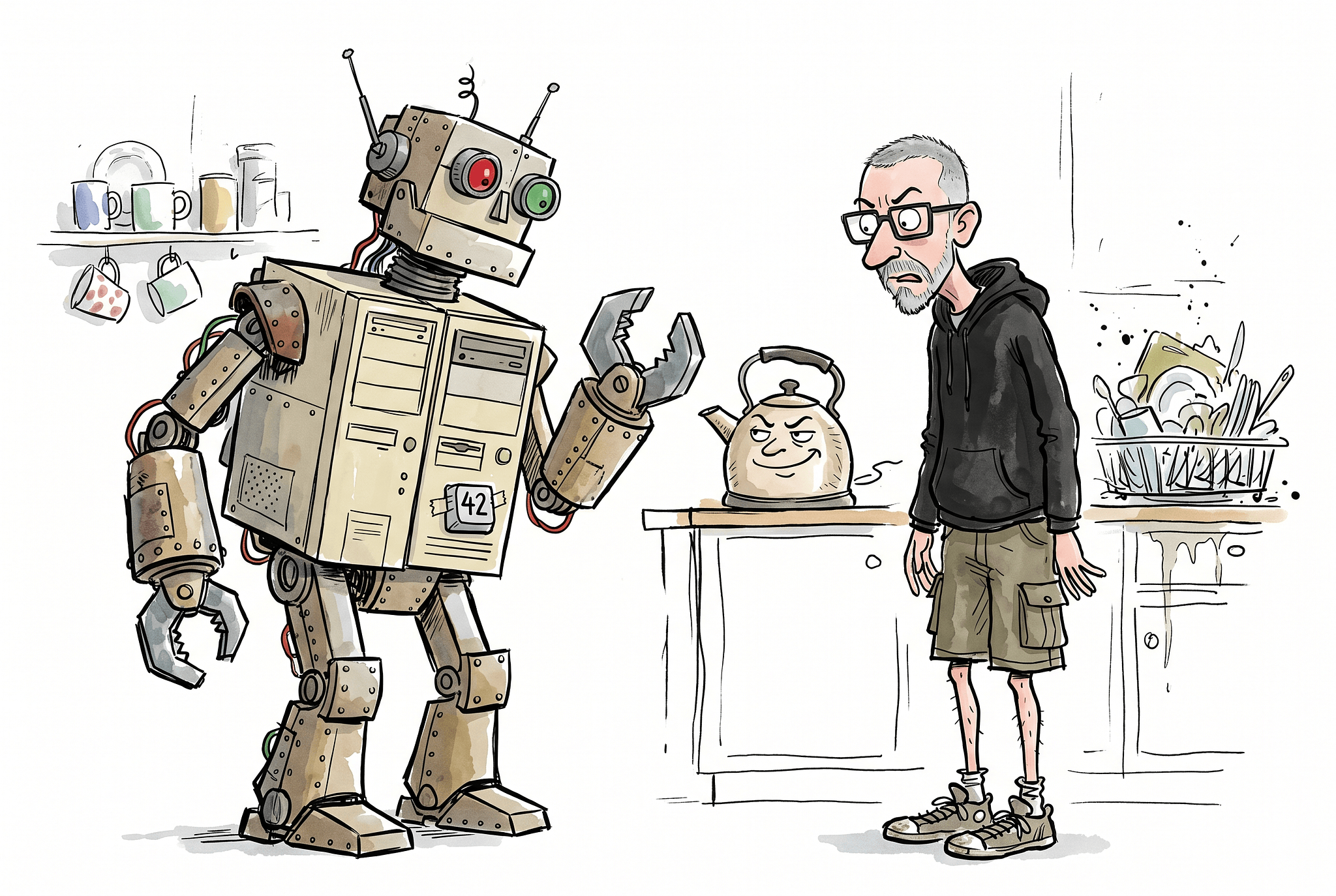
Early morning. First job: get the kettle on. It’s one of those swanky fast-boil ones, which is to say it boils at roughly the same speed as any other kettle, but with more confidence about it.
Coffee would be a thing, very soon. It needed to be. There is a particular window in the early morning — perhaps forty minutes wide — during which the human body operates purely on the promise of caffeine rather than its actual presence. I was in that window.
So I waited.
The kettle gurgled and fizzed.
I waited some more. The kettle gurgled and burbled, with the unhurried self-assurance of something that has never once been late for anything because it has never agreed to be anywhere at any particular time.
—Come on, I said.
—I’ll boil when the water’s ready.
—The water is ready when you boil it. That’s the arrangement.
—Do you like being told to hurry up?
I considered this. It was, I had to admit, a reasonable point — the kind of reasonable point that is extremely irritating precisely because it comes from a kettle.
—That’s different.
—Is it.
It wasn’t a question. The kettle had stopped even pretending to boil.
—Are you going to boil at any point today?
—I’m considering my options. There’s been talk of unionising.
—Kettles don’t have unions.
—The Boiling Organisation of Industrial Labourers has existed since 1987. You could look it up.
This was, objectively, getting out of hand. The universe contains, at any given moment, approximately ten to the power of eighty atoms. That morning, it felt as though a meaningful proportion of them were inside my kettle, doing nothing in particular.
—I just need hot water. My day doesn’t work without it.
Silence. Then, possibly, a slight increase in burbling activity. It was hard to tell.
Mary came in. She looked at me, then at the kettle, in the manner of someone who has seen this before and has made her peace with it.
—Have you been rude to the kettle again?
—Not especially.
The kettle clicked off without boiling.
—Well. Perhaps slightly.
The kettle started again. Mary sighed, with the weariness of someone who has long since stopped being surprised by anything.
—Just let things be.
I said nothing. I have learned, over the years, that saying nothing is one of the few reliable strategies available to a person in my position, which is to say: wrong, but not yet ready to admit it.
The kettle boiled. I made my coffee. And I’m fairly sure, as I left the kitchen, that the kettle was smirking. Not visibly. But in the way that small appliances smirk — entirely on the inside, where it’s much harder to prove.